Аристотель «Поэтика»: Общее и конкретное в действии (1451a36)
Перевод М. Гаспарова
[b11] Что в комедии это так, уже не вызывает сомнений: <здесь поэты,> составив сказание по <законам> вероятности, дают <действующим лицам> произвольные имена, а не пишут, как ямбографы, <карикатуры> на отдельных лиц. [b15] В трагедиях же придерживаются имен, действительно бывших, — ибо убедительно (πιθανόν) бывает <только> возможное, а мы сомневаемся в возможности того, чего не было, и воочию видим возможность того, что было: ведь, будь оно невозможно, его бы и не было. [b19] Да и в некоторых трагедиях бывает
[b27] Итак, отсюда ясно, что сочинитель должен быть сочинителем не столько метров, сколько сказаний: ведь сочинитель он постольку, поскольку подражает, а подражает он действиям. [b29] Впрочем, даже если ему придется сочинять <действительно> случившееся, он все же останется сочинителем — ведь ничто не мешает тому, чтобы иные из случившихся событий были таковы, каковы они могли бы случиться по вероятности и возможности; в этом отношении он и будет их сочинителем.
[b33] Из простых сказаний и действий самые слабые — эпизодические. Эпизодическим сказанием я называю такое, в котором эпизоды следуют друг за другом без вероятия и без необходимости. [b35] Такие сказания складываются у дурных поэтов по собственной их вине, а у хороших — ради актеров: давая им <случай> к соревнованию и растягивая сказание сверх его возможностей, они часто бывают вынуждены искажать последовательность <событий>.
[52а1] А так как <трагедия> есть подражание действию не только законченному, но и <внушающему> сострадание и страх, а это чаще всего бывает, когда
Перевод В. Аппельрота
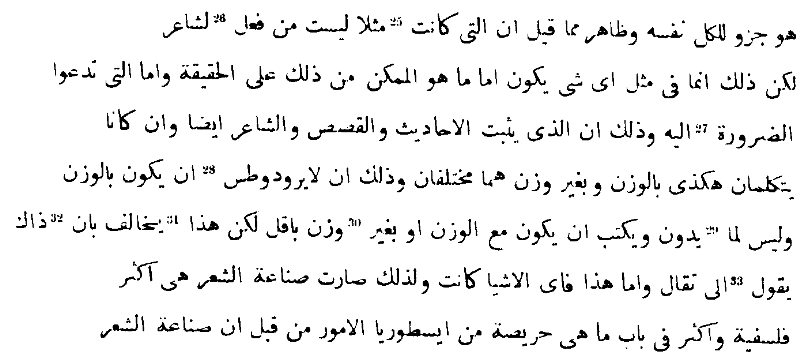
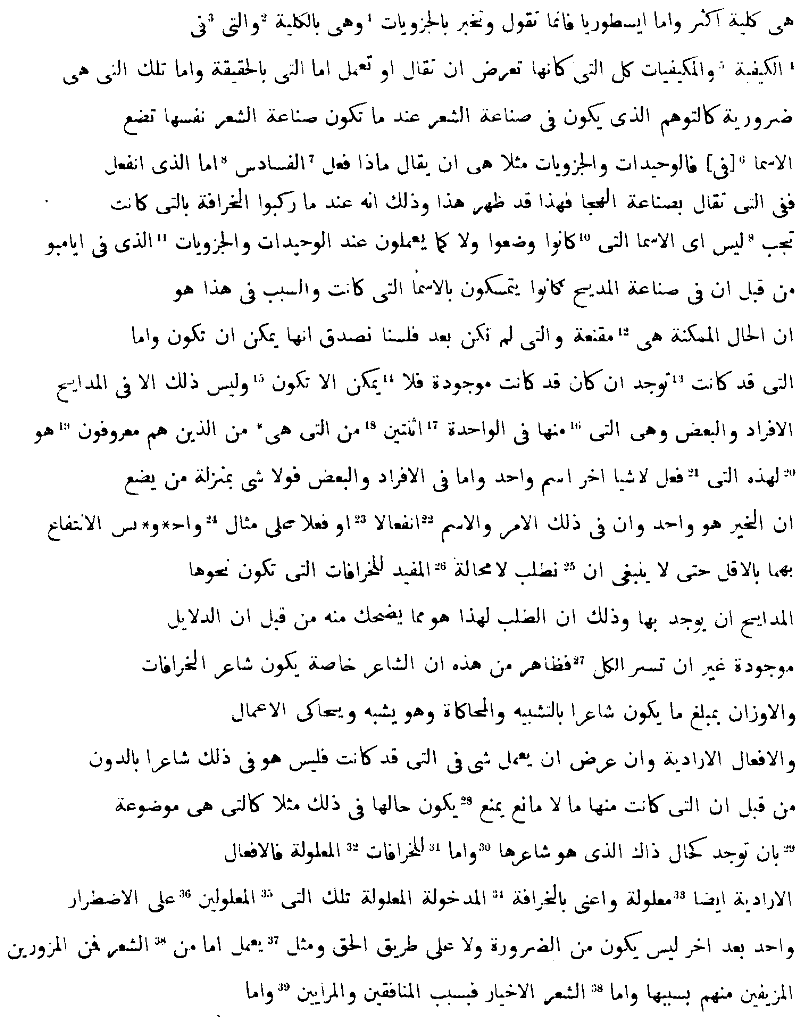
Именно, историк и поэт отличаются [друг от друга] не тем, что один пользуется размерами, а другой нет: можно было бы переложить в стихи сочинения Геродота, и тем не менее они были бы историей как с метром, так и без метра; но они различаются тем, что первый говорит о действительно случившемся, а второй — о том, что могло бы случиться. Поэтому поэзия философичнее и серьезнее истории: поэзия говорит более об общем, история — о единичном. Общее состоит в том, что человеку
Из простых фабул и действий самые худшие — эписодические; а эписодической фабулой я называю такую, в которой эписодии следуют друг за другом без всякого вероятия и необходимости. Подобные [трагедии] сочиняются плохими поэтами вследствие их собственной бездарности, а хорошими — ради актеров: именно, устраивая состязания и [поэтому] растягивая фабулу вопреки ее внутреннему содержанию, они часто бывают вынуждены нарушать естественный порядок действия.
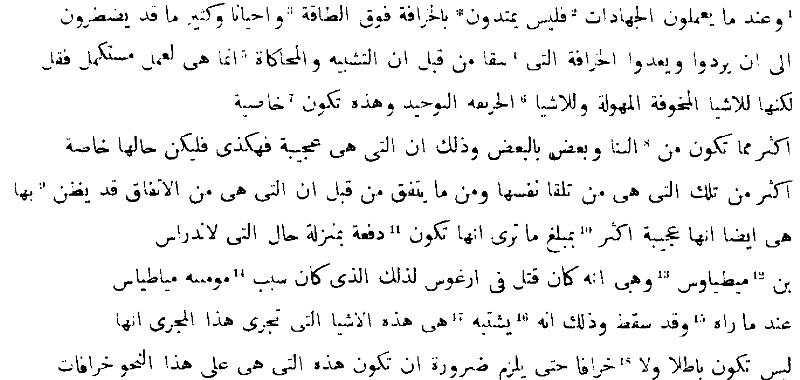
[Трагедия] есть подражание не только законченному действию, но также страшному и жалкому, а последнее происходит особенно тогда, <когда случается неожиданно>, и еще более, если случится вопреки ожиданию и одно благодаря другому, ибо таким образом удивительное получит бoльшую силу, нежели если бы оно произошло само собой и случайно, так как и из случайного наиболее удивительным кажется все то, что представляется случившимся как бы с намерением, например то событие, что статуя Мития в Аргосе убила виновника смерти этого Мития, упав на него в то время, как он на нее смотрел; подобные вещи кажутся случившимися не без цели. Следовательно, подобные фабулы необходимо будут лучшими.
Перевод Н. Новосадского
Из простых фабул и действий эпизодические самые худшие. Эпизодической я называю ту фабулу, в которой вводные действия следуют одно за другим без соблюдения вероятности и необходимости. Такие фабулы составляются плохими поэтами по их собственной вине, а хорошими —
Трагедия есть воспроизведение не только законченного действия, но также вызывающего страх и сострадание, а это бывает чаще всего в том случае, когда
Translated by W.H. Fyfe
Of «simple» plots and actions the worst are those which are «episodic». By this I mean a plot in which the episodes do not follow each other probably or inevitably. Bad poets write such plays because they cannot help it, and good poets write them to please the actors. Writing as they do for competition, they often strain a plot beyond its capacity and are thus obliged to sacrifice continuity. But this is bad work, [1452a][1] since tragedy represents not only a complete action but also incidents that cause fear and pity, and this happens most of all when the incidents are unexpected and yet one is a consequence of the other. For in that way the incidents will cause more amazement than if they happened mechanically and accidentally, since the most amazing accidental occurrences are those which seem to have been providential, for instance when the statue of Mitys at Argos killed the man who caused Mitys’s death by falling on him at a festival. Such events do not seem to be mere accidents. So such plots as these must necessarily be the best.
Translated by S.H. Butcher
Of all plots and actions the episodic are the worst. I call a plot ‘episodic’ in which the episodes or acts succeed one another without probable or necessary sequence. Bad poets compose such pieces by their own fault, good poets, to please the players; for, as they write show pieces for competition, they stretch the plot beyond its capacity, and are often forced to break the natural continuity.
But again, Tragedy is an imitation not only of a complete action, but of events inspiring fear or pity. Such an effect is best produced when the events come on us by surprise; and the effect is heightened when, at the same time, they follows as cause and effect. The tragic wonder will then be greater than if they happened of themselves or by accident; for even coincidences are most striking when they have an air of design. We may instance the statue of Mitys at Argos, which fell upon his murderer while he was a spectator at a festival, and killed him. Such events seem not to be due to mere chance. Plots, therefore, constructed on these principles are necessarily the best.
Translated by I. Bywater
It i.e.ident from the above that, the poet must be more the poet of his stories or Plots than of his verses, inasmuch as he is a poet by virtue of the imitative element in his work, and it is actions that he imitates. And if he should come to take a subject from actual history, he is none the less a poet for that; since some historic occurrences may very well be in the probable and possible order of things; and it is in that aspect of them that he is their poet.
Of simple Plots and actions the episodic are the worst. I call a Plot episodic when there is neither probability nor necessity in the sequence of episodes. Actions of this sort bad poets construct through their own fault, and good ones on account of the players. His work being for public performance, a good poet often stretches out a Plot beyond its capabilities, and is thus obliged to twist the sequence of incident.
Tragedy, however, is an imitation not only of a complete action, but also of incidents arousing pity and fear. Such incidents have the very greatest effect on the mind when they occur unexpectedly and at the same time in consequence of one another; there is more of the marvellous in them then than if they happened of themselves or by mere chance. Even matters of chance seem most marvellous if there is an appearance of design as it were in them; as for instance the statue of Mitys at Argos killed the author of Mitys’ death by falling down on him when a
Traduction Ch. Emile Ruelle
I. Il est évident, d’après ce qui précède, que l’affaire du poète, ce n’est pas de parler de ce qui est arrivé, mais bien de ce qui aurait pu arriver et des choses possibles, selon la vraisemblance ou la nécessité.
II. En effet, la différence entre l’historien et le poète ne consiste pas en ce que l’un écrit en vers, et l’autre en prose. Quand l’ouvrage d’Hérodote serait écrit en vers, ce n’en serait pas moins une histoire, indépendamment de la question de vers ou de prose. Cette différence consiste en ce que l’un parle de ce qui est arrivé, et l’autre de ce qui aurait pu arriver.
III. Aussi la poésie est quelque chose de plus philosophique et de plus élevé que l’histoire; car la poésie parle plutôt de généralités, et l’histoire de détails particuliers.
IV. Les généralités, ce sont les choses qu’il arrive à tel personnage de dire ou de faire dans une condition donnée, selon la vraisemblance ou la nécessité, et c’est à quoi réussit la poésie, en imposant des noms propres. Le détail particulier c’est, par exemple, ce qu’a fait Alcibiade ou ce qui lui a été fait.
V. On a déjà vu procéder ainsi pour la comédie. Après avoir constitué une fable d’après les vraisemblances, les poètes comiques imposent, de la même manière, n’importe quels noms, mais non pas, à la façon dont s’y prennent les ïambographes, pour composer sur des faits personnels.
VI. Pour la tragédie, les poètes s’emparent des noms de personnages qui ont existé. La raison en est que ce qui est possible est probable; or, ce qui n’est pas arrivé, nous ne croyons pas encore que ce soit possible; mais ce qui est arrivé, il est évident que c’est possible, car ce ne serait pas arrivé si c’était impossible.
VII. Néanmoins, dans quelques tragédies, il y a un ou deux noms connus, et les autres sont fictifs; dans quelques autres, il n’y en a pas un seul de connu, par exemple dans la Fleur, d’Agathon; car, faits et noms, tout y est imaginaire, ce qui n’empêche pas que cette pièce fait plaisir.
VIII. Ainsi donc il ne faut pas affecter de s’en tenir de tout point aux fables traditionnelles sur lesquelles il existe déjà des tragédies. Cette affectation serait ridicule, car les sujets connus ne le sont que d’un petit nombre et, cependant, font plaisir à tout le monde.
IX. Il est évident, d’après cela, que le poète doit être nécessairement un faiseur de fables plutôt qu’un faiseur de vers, d’autant qu’il est poète par l’imitation : or il imite des actions; donc, lors même qu’il lui arrive de composer sur des faits qui sont arrivés, il n’en sera pas moins un poète, car rien n’empêche que
X. Parmi les fables et les actions simples, les plus mauvaises sont les épisodiques; or j’entends par « fable épisodique» celle où la succession des épisodes ne serait conforme ni à la vraisemblance, ni à la nécessité. Des actions de cette nature sont conçues par les mauvais poètes en raison de leur propre goût, et, par les bons, pour condescendre à celui des acteurs. En effet, composant des pièces destinées aux concours, développant le sujet au delà de l’étendue possible, ils sont forcés de rompre la suite de l’action.
XI. Mais comme l’imitation, dans la tragédie, ne porte pas seulement sur une action parfaite, mais encore sur des faits qui excitent la terreur et la pitié, et que ces sentiments naissent surtout lorsque les faits arrivent contre toute attente, et mieux encore lorsqu’ils sont amenés les uns par les autres, car, de cette façon, la surprise est plus vive que s’ils surviennent à l’improviste et par hasard, attendu que, parmi les choses fortuites,
Перевод Абу-Бисра, не позднее 940 г.